PCB Design Review

Probe - Design review

Probe in short: a web-based design-review tool working directly on ODB++, BOM and PDF schematics. Allows cross-probing, automatic power-tree discovery, and plain-language review with every finding cited to the design data. AI runs through your own LLM; on-premises, so no design data leaves your organisation.

No geometric DRC or DFM, it complements your current CAD applications rather than competing with them.

Book a demo
  • Earlier - Review from schematic and BOM, before any layout exists.
  • Fewer spins - A functional error caught in review is one you don’t find at production.
  • Shorter schedule - Fewer iterations between a design and hardware that works.

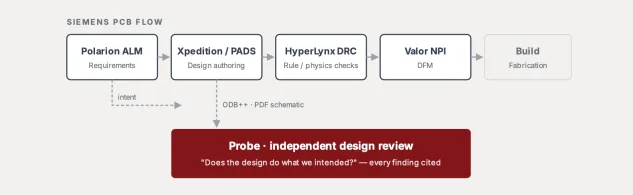
Where Probe fits in Siemens' PCB Design flow

The Siemens PCB portfolio covers design authoring, manufacturing checks, rule/physics checks and requirements management. Probe fills the gap between them: independent design review at the intent level.

It answers a different question from any Siemens tool, not “can this be built?” or “is this spacing legal?”, but “does the design do what we intended?” with every finding cited back to the netlist, datasheet or layout it rests on.

Why teams ship faster

Catch the error before the prototype


An intent error that slips through review shows up at bring-up where the fix is a respin and weeks of schedule. Probe puts those errors on screen during review, pre-layout if you want, so they’re caught while a fix is still an edit, not a spin.
Ask the board

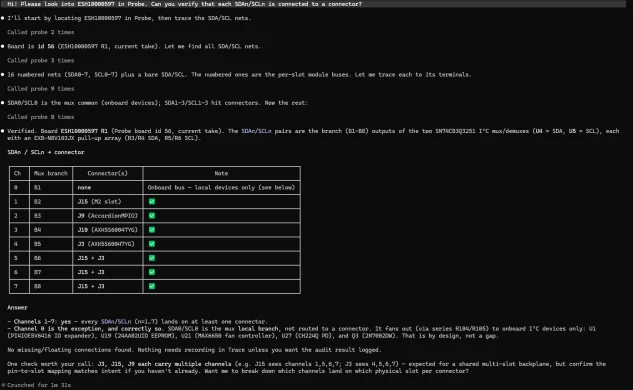
Ask your board and get cited answers


The review runs through an AI assistant over MCP: you ask in plain language, Probe answers from the real board data, and shows the net or finding behind the answer as proof. You’re not clicking through a viewer, you’re querying the design.

Answers are traced, not guessed. Probe cites the netlist line, layout location or datasheet value it drew from, and where it can’t back a claim it says so. Citations are checked verbatim, and a claim the data can’t support is refused at the write boundary, not dressed up as a guess.

What Probe catches

The mistakes a clean DRC waves through


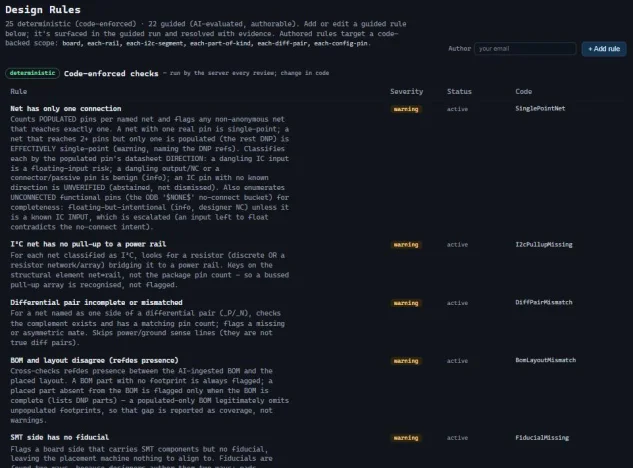
Ten findings from our own boards. Every one passes DRC, ERC and a netlist check against the schematic and each looks locally correct. The error only shows when two facts from different places are put side by side:

  • A current source whose own readback can’t see its shunt — a wrong shunt still reads perfect.
  • Twenty-eight unspecified BOM positions, each one bypassing an eFuse’s protection.
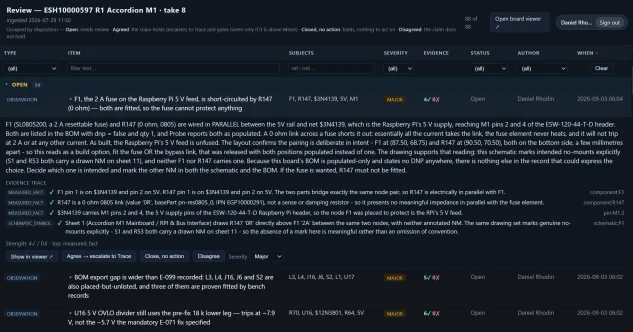
  • A resettable fuse shorted by a fitted 0 Ω link — the rail ships unfused.
  • A rail believed to be switched that still feeds the DUT when its converter is disabled.
  • One letter in a part number that inverts the fail-safe and pulls an I²C bus low.
  • A fix that re-referenced a supply and pushed two pins past absolute maximum.
  • A “1.8 V” rail that really lands between 1.72 V and 2.11 V once the regulator’s own bias is counted.
  • A 12 V rail whose worst case trips its own supervisor — because the BOM sets no resistor tolerance.
  • A net named …_OUT that is really the switch node, carrying the full switching waveform.
  • Two connectors on one adaptor, one pin apart — odd and even swapped throughout.

A rule checker knows the rules of the board. Probe reads the parts.


Evidence, not opinion

Every finding carries its proof


Review findings today are opinions that get lost in email; Probe makes them cited facts that stay. A finding carries its proof: the netlist line, the layout location, the datasheet value. The engineer who has to fix it verifies it in one click instead of re-deriving it.

And where Probe can’t ground a claim in the board’s data, it says so rather than guessing. An abstention you can act on beats a confident answer that’s wrong.

Across designs

Findings that carry forward


A finding is worth more than the meeting it was raised in, but that’s usually where it dies, in a thread or a PDF margin, gone by the next project. Probe keeps findings as cited facts attached to the net and the component they concern.

A note stored on a part is inherited by every future board that carries it, so the next review starts from what the last one already found, not from zero.

open the design

Cross-probe the board; everyone and any CAD

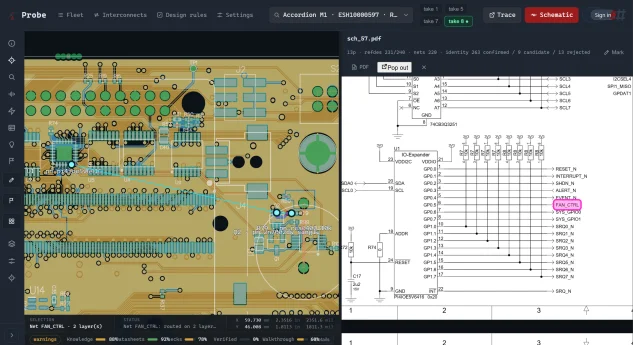
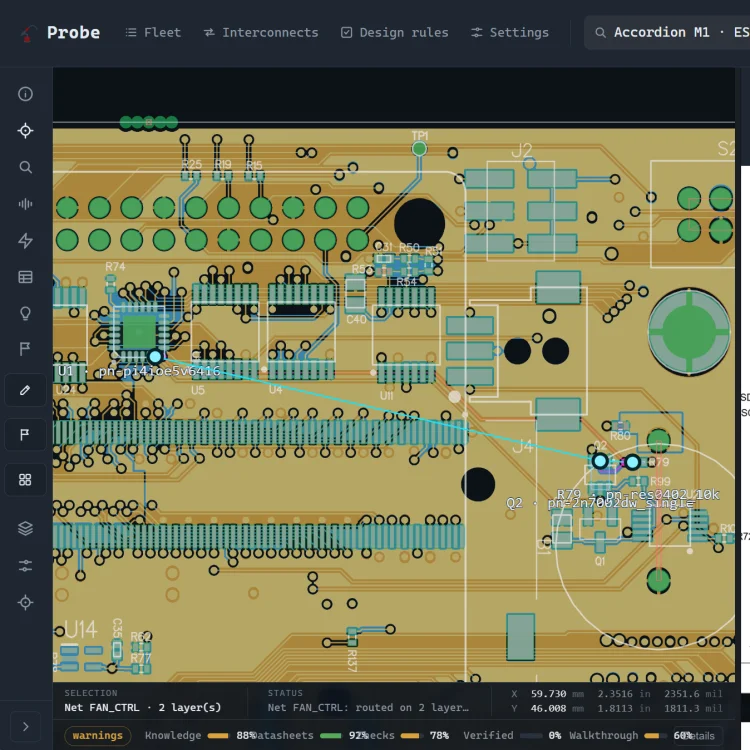
A viewer shows you shapes; Probe knows what they’re connected to. Cross-probe a net from the schematic to the layout and back, follow it through connectors and planes, and search the whole design. Viewing is free, no CAD seat to look.

i want to book a demo

Fields with * are required