Enhancing and Improving Dissolved Air Flotation Units

Enhancing and Improving Dissolved Air Flotation Units

Marel wanted to know if they could extend their existing model range of concrete DAF units with a next larger one. They were also curious if they could assess risks and performance without actually building the unit.

I want to know more about CFD software
  • Adoption of CFD software
  • Significant cost savings
  • Improved performance
  • Meet market demands

Introduction

Marel Water Treatment, part of JBT Marel, reduces water stress on the local environment by providing solutions for all types of food processing wastewater. This helps processors minimize wastewater, enhance efficiency and increase sustainability.

Dissolved air flotation (DAF) units play a critical role in pretreatment of wastewater. Marel Water Treatment wanted to design a larger version of its existing concrete DAF unit that would allow for 25 percent more throughput. At the same time, the company wanted to optimize the performance of its entire range of both stainless steel and concrete DAF units.

Challenge

Bernold Leferink, Process Engineer at Marel Further Processing B.V. Boxmeer, and Bas Ubbink, Manager Engineering at Marel Water Treatment B.V. Lichtenvoorde, explained that they needed to update an entire model range (expand and optimize) of existing flotation units due to market demands. 

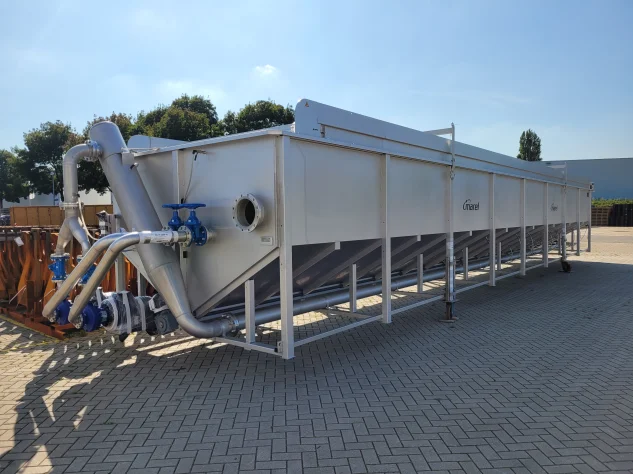
Marel offers two types of flotation units; a stainless steel flotation unit model range and, for larger flows, a concrete flotation unit. Concrete flotation units are mainly used in China due to the transport costs of the stainless steel units. The stainless steel flotation unit is already available in different sizes. Scaling up requires a careful assessment of the anticipated performance to keep risks acceptable. Building and testing a larger unit on site was considered too expensive. 

Here's where CFD simulation comes into play - Computational Fluid Dynamics (CFD) refers to the numerical method of simulating steady and unsteady fluid motion, using computational methods and hardware.

The main reasons for investigating if CFD was usable for extending the existing model range of concrete DAF units with a next larger one unit were:

  • Building and testing a concrete flotation unit here was too expensive and too risky
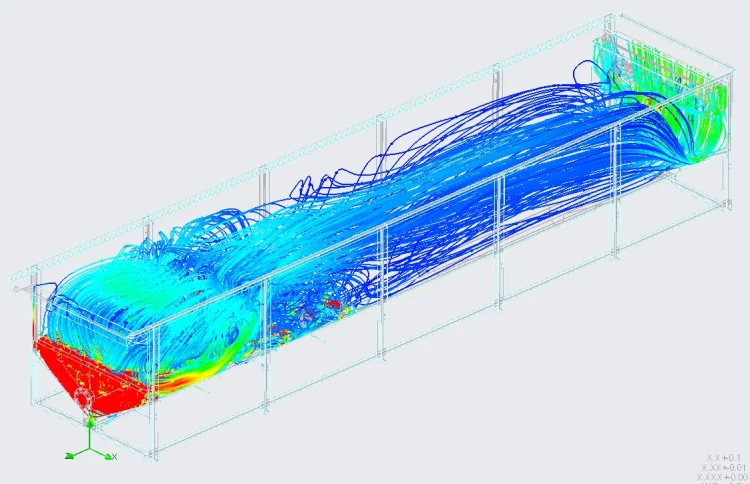
  • There’s no visual sight on how the water behaves in a flotation unit, complicating proper judgements about the performance of the unit
  • Time and cost saving because there’s no need to build multiple test components
  • Setting up flow simulations based on the CAD model is fast and design variants can be easily investigated (essential for model ranges and investigating possible improvements)

In addition, Marel needed to verify that CFD simulation could accurately model the complex physics of these units so that they could use CFD simulation to design the large concrete flotation unit.

DAF unit

A Dissolved Air Flotation (DAF) unit is part of the primary water treatment process where the following will be removed: sediment, most of the suspended solids and fat, oil and grease (FOG). If the DAF is preceded by a coagulation and flocculation system also emulsified and colloidal matter can be removed. 

In the saturation tank/tube (part of the DAF), water is saturated with air under pressure (~6 bar). The pressurized water is released in the flotation unit through nozzles, where the pressure is atmospheric. The released air forms tiny bubbles which adhere to the similar sized or bigger suspended matter. As more bubbles form, the lift force on the bubbles eventually overcomes the force of gravity, causing the suspended matter to float to the surface. The sludge is then removed by a skimming device to a sludge compartment or chute.

The cleaned water is discharged from the flotation unit via an overflow weir.

Solution

To address this, Marel decided to utilize CFD simulations. They started by setting up the CFD model in Simcenter FLOEFD. After performing their initial CFD analyses, they “challenged” the CFD simulations by performing measurements. This was an essential step to ensure they had set up a correct CFD model, capturing the complex physics correctly. Obviously the CFD simulations helped set up the measurement plan: where to measure and what to expect. 

After comparing measurements and simulations, where possible, and finding reasonable agreement, they felt confident in the design of their CFD model and took the step of investigating the unit design and model variants using CFD modeling.

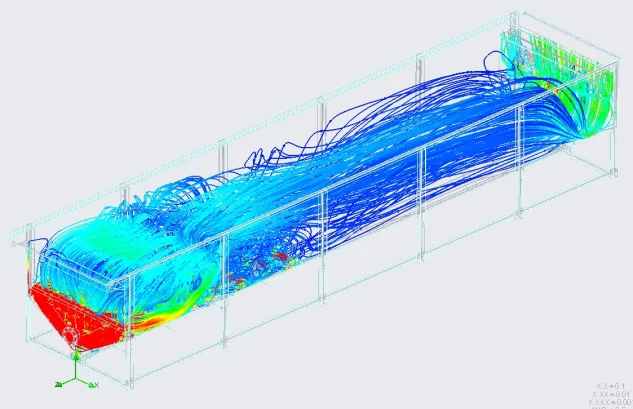
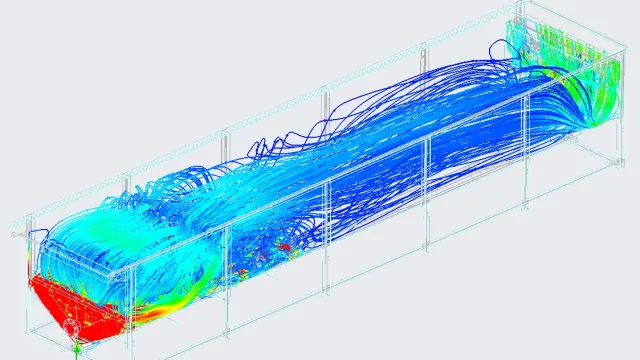
Using Simcenter FLOEFD, the team was able to simulate the main fluid flow, add particles to model air bubbles and observe their behaviour within the unit. This approach revealed potential improvements, such as optimizing the inlet structure to ensure efficient use of the unit's length.

Implementation

During the first simulations, practical challenges emerged, such as determining the best inlet structure to realize a good influent flow distribution.

Simcenter FLOEFD proved invaluable in calculating these dynamics, allowing Marel to see where improvements were needed. Group discussions, including feedback from mechanical design engineers, customer support engineers, process engineers and water technologists, helped refine the designs based on simulation results. Initial testing with the stainless steel unit revealed further opportunities for improvement, which were then applied to both the stainless steel and concrete units. This iterative process of simulating, testing, and refining ensured the new designs were both effective and efficient.

Results

The new larger concrete flotation unit, developed using Simcenter FLOEFD, has been successfully deployed in several projects, demonstrating required performance. The stainless steel unit also underwent significant improvements, benefiting from the insights gained during the simulation process.

The key benefits of using Simcenter FLOEFD are:

  • Cost and time savings: Avoiding the need to build and test a larger concrete unit locally saved significant costs. Simulations could be run overnight, making the process efficient and timely.
  • Improved performance: the stainless steel units have been improved and operate more efficiently, with better separation of solids from wastewater.
  • Knowledge retention: by keeping the simulation and design process in-house, Marel was able to quickly iterate on designs and retain valuable knowledge for future projects.

Conclusion

Marel’s adoption of Simcenter FLOEFD CFD software has revolutionized their approach to designing flotation units. By simulating and validating designs before implementation, they have achieved significant cost savings, improved unit performance and retained critical knowledge within the organization. Simcenter FLOEFD has become an indispensable tool for Marel, driving innovation and ensuring their flotation units efficiently meet market demands.

Download case study

Discover how Marel successfully made use of Simcenter FLOEFD

"FLOEFD software allowed us to cut costs and time by eliminating local testing and running simulations overnight.”

"Simcenter FLOEFD CFD software allowed us to cut costs and time by eliminating local testing and running simulations overnight. Our flotation units now perform more efficiently and by keeping the process in-house, we retained valuable knowledge for rapid future improvements.” Bernold Leferink and Bas Ubbink – Marel

Bernold Leferink Marel

About Marel Food Processing

Marel is a global leader in transforming the way food is processed. They support the production of high quality, safe and affordable food by providing solutions, services and software to the poultry, fish, plant, pet and feed processing industries.

Sustainability is at the core of their business, their groundbreaking solutions reduce waste while improving yields and creating economic value.
With a network of around 7,500 people in over 30 countries, they’re always close by and ready to help. From the first spark of inspiration to implementing a solution, they’re committed to excellence in everything they do.

Marel’s vision: a world where quality food is produced sustainably and affordably. They are guided by three core values: unity, innovation and excellence.
Every connection counts. Ranging from a single machine to an entire processing line, their groundbreaking solutions are tailor made - a guarantee of safety, traceability and quality throughout the value chain.

// 7,500 employees // 30+ countries with Marel offices // 100 partners // https://marel.com

About Simcenter FLOEFD

Simcenter FLOEFD for Creo is an award-winning CAD-embedded CFD simulation tool for easy, fast, robust and accurate fluid flow and heat transfer analysis and is fully embedded with Creo (and Pro/ENGINEER) for fluid flow and thermal simulation. It helps shorten development by up to 65-75% compared to typical CFD approaches by frontloading fluid flow simulation and thermal analysis and using native CAD geometry. It enables design engineers to perform simulation earlier in the design process when it is more cost-effective to identify and fix problems or explore improvements. Integrated in CAD, it has shown improved productivity by a factor of x2 to x40.

Using this software, you can easily compare designs using side-by-side with CFD result visualizations, plots and tabular results and generating reports in just a few clicks. When your design is optimized using simulation, you can directly communicate the CAD model to other engineering functions.

More information
Simcenter FLOEFD for Creo CFD Software

CONTACT US ABOUT Simcenter FLOEFD OR REQUEST A QUOTE

Fields with * are required